Categories:
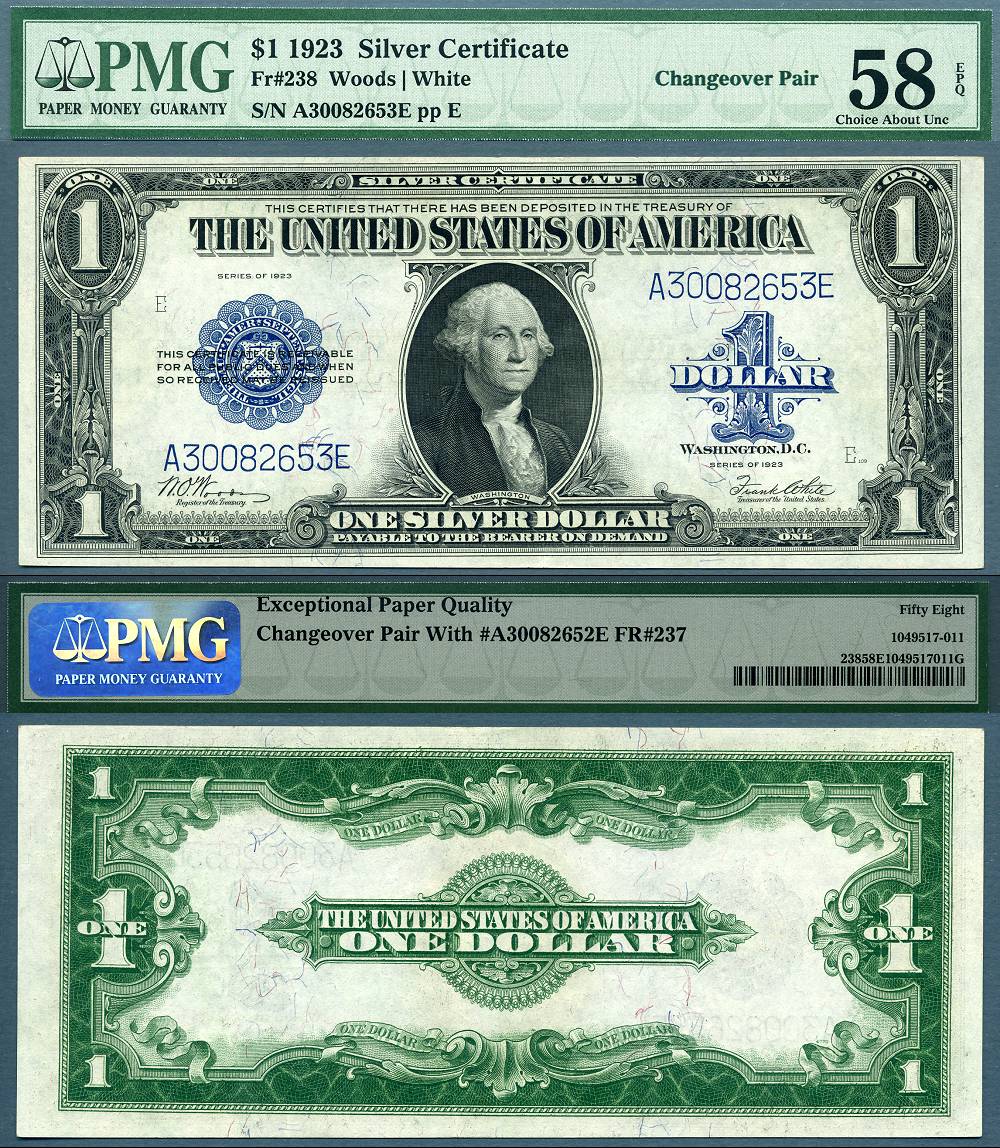
What Is a Change Over Pair? In This Case It's When You Have Two Consecutive Numbered Notes but The Signatures Are Different. See Scan Below You Will See Note S/N A30082652E Has the Signatures of Speelman & White Where S/N A30082653E Has the Signatures of Woods & White.

Front: The Second Note of The Educational Series, Engraved by Charles Schlecht and G.F.C. Smillie After Designs by Edwin H. Blashfield (Figures) and Thomas F. Morris (Frame, Background) Science Presenting Steam and Electricity to Commerce and Manufacture. Back: Heads of Inventors Robert Fulton and Samuel F. B. Morse. The Portraits Are Attributed to Engraver Lorenzo J. Hatch.
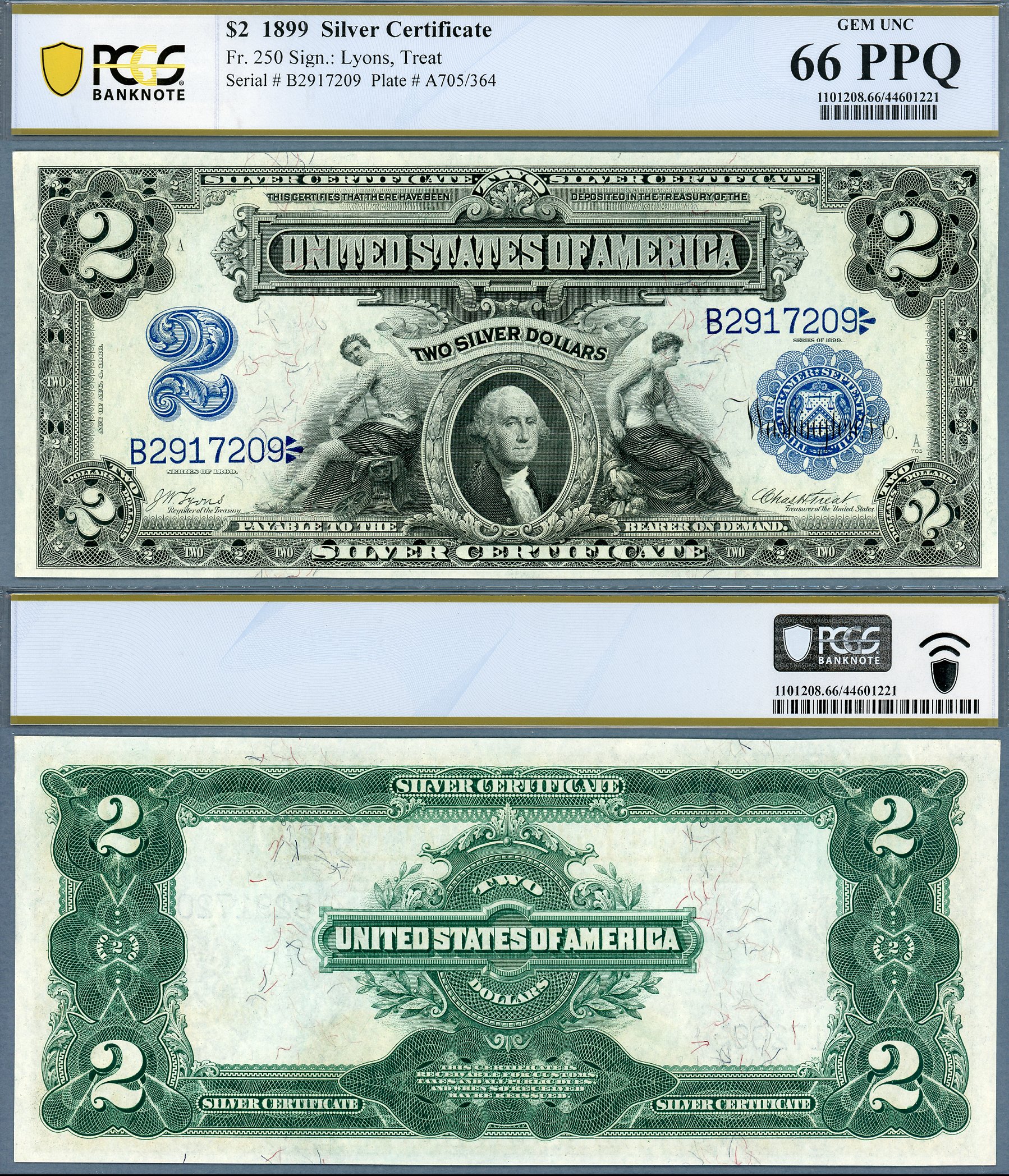
Front: Portrait of George Washington between figures of Mechanics and Agriculture. The FR-250 Signatures of Lyons and Treat is the 2nd hardest to come by with only 237 Known and not many will grade higher than this one.

The extremely popular Five Silver Dollar Back is the Silver Certificate issue of Series 1886. The front features the head of Ulysses S. Grant, 18th President of the United States from 1869-1873. Unlike most notes, where this face is the most important feature, this note gained popularity because of its back design. Five Morgan Silver dollars, dated 1886, fill almost the entire back of the note. They represent the amount of silver coinage for which the bill could be redeemed at the time. Because the reverse of four of the dollars is shown, the phrase “In God We Trust” is seen on US currency for the first time. Not until 1957 was this motto adopted for use on US currency. This series was issued with one of four seal types, large and small red seals, scalloped and plain, and a large brown seal. This note with a small, red seal.

The extremely popular Five Silver Dollar Back is the Silver Certificate issue of Series 1886. The front features the head of Ulysses S. Grant, 18th President of the United States from 1869-1873. Unlike most notes, where this face is the most important feature, this note gained popularity because of its back design. Five Morgan Silver dollars, dated 1886, fill almost the entire back of the note. They represent the amount of silver coinage for which the bill could be redeemed at the time. Because the reverse of four of the dollars is shown, the phrase “In God We Trust” is seen on US currency for the first time. Not until 1957 was this motto adopted for use on US currency.